


A NEWBORN baby was pictured “victoriously” holding the contraceptive IUD (intrauterine device) that was supposed to prevent his mum from becoming pregnant — just moments after birth.
The baby’s mother, Queidy Araujo de Oliveira, had been using the IUD for two years when she unexpectedly discovered she was pregnant during a routine check-up. Despite the device being more than 99 per cent effective at preventing pregnancy, in this rare case it failed.
Photos taken shortly after delivery show the baby clutching the small T-shaped device in his tiny hand, a moment that quickly went viral online. Many viewers called the scene “a symbol of victory,” while others remarked on the extraordinary irony of the baby being born holding the very object that was supposed to stop his existence.
IUDs are considered one of the most effective forms of birth control, but like all contraceptives, they are not completely foolproof. Rare failures can occur if the device becomes displaced or expelled from the uterus without being noticed.
For Queidy, the surprise pregnancy turned into a blessing. Both mother and baby are reported to be healthy, and their remarkable story has captured attention around the world — reminding everyone that sometimes, life has its own plans.


Matheus Gabriel pictured holding the IUD. Credit: Newsflash
His mother had relied on the IUD for two years before learning she was pregnant.
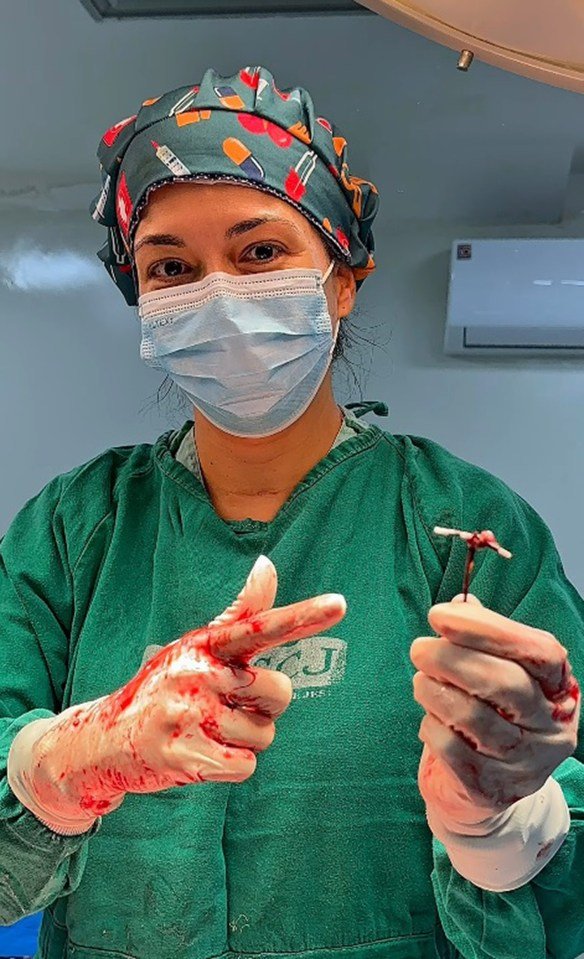
Dr. Natalia Rodrigues carried out the delivery and placed the IUD in the newborn’s hand.
Little Matheus Gabriel was delivered at the Hospital Sagrado Coração de Jesus in Nerópolis, Brazil — but it wasn’t his arrival alone that caught the world’s attention.

Dr. Natalia Rodrigues, who oversaw the birth, jokingly placed the copper intrauterine device in the newborn’s hand and filmed the unusual scene. The clip, posted on social media on September 1st, shows Matheus clenching the IUD tightly in his fist. It was captioned: “Holding my victory trophy: the IUD that couldn’t handle me!”
IUDs are considered one of the most effective forms of contraception, with success rates above 99 per cent. There are two main types: copper IUDs and hormonal IUDs (also known as intrauterine systems, or IUS). Copper devices work by creating an immune response that makes the uterus hostile to sperm and prevents implantation, while hormonal devices release progestin to thicken cervical mucus and thin the uterine lining.
The device used by Matheus’s mother, Queidy Araujo de Oliveira, was a copper IUD — with a failure rate of just 0.6 per cent. Yet in her case, the rare happened.
“During an IUD follow-up, during the ultrasound to check on the condition, I found out I was pregnant,” Dr. Natalia explained. “The reaction was desperate.”
Because removing the device could have put the unborn baby at risk, doctors decided to leave it in place for the duration of the pregnancy.
Queidy described her journey as anything but easy. She experienced bleeding and detachment issues throughout, but in the end, Matheus was born healthy.

Her husband, who had been waiting to undergo a vasectomy, joked online that after their unexpected miracle, “the factory is now closed.”
IUDs Explained: What You Should Know
An intrauterine device (IUD) — sometimes called a copper coil — is a small, T-shaped piece of plastic that a doctor or nurse places inside the womb (uterus) to help prevent pregnancy.
It begins working immediately after insertion and can remain effective for five to ten years, depending on the type. Once removed, fertility usually returns right away.
Who Can and Can’t Use an IUD
While an IUD is one of the most effective methods of contraception, it isn’t suitable for everyone. You may not be a good candidate if:
- You are pregnant or think you might be.
- You have an untreated pelvic or sexually transmitted infection (STI).
- You experience unexplained vaginal bleeding.
- You have certain conditions affecting your uterus.
It’s also important to note that an IUD does not protect against STIs. The NHS recommends using condoms alongside the IUD to reduce the risk of infections, including HIV.
Why IUDs Sometimes Fail
Although highly effective, an IUD can occasionally become less reliable due to:
- Expulsion – the device shifts or falls out of place, often linked to uterine shape or a difficult insertion.
- Malposition – the IUD sits too low or isn’t placed correctly, reducing its effectiveness.
- Perforation – in rare cases, the device can push through the uterine wall during or after insertion.
Aftercare and Check-Ups
Routine follow-up appointments aren’t usually required in the UK, but many providers suggest checking your IUD strings once a month. You should seek medical advice if you:
- Can’t feel the strings.
- Experience unusual pain, fever, or abnormal discharge.
- Have very heavy bleeding.
- Suspect the IUD has shifted or fallen out.
Some clinics recommend a check-up around 3–6 weeks after insertion, while others combine this with your annual exam.
Choosing the Right Contraception
There are many contraception options available through the NHS and private providers. Deciding which is best for you can depend on lifestyle, health conditions, and personal preference.
Things to consider:
- Convenience – Some methods, like the coil or implant, last for years. Others, such as the pill or condoms, need to be taken or used daily or during every sexual encounter.
- Side effects – Hormonal methods can cause headaches, mood swings, nausea, sore breasts, or acne. There are also very small risks of blood clots and certain cancers, making them unsuitable for some people.
- Effectiveness – Long-acting methods like the coil, implant, and injection are typically 99% effective. Pills and patches are also highly effective if used correctly. Condoms, however, can sometimes break, and natural family planning methods tend to be less reliable.
Contraception Options at a Glance
- Combined pill – contains progestogen and oestrogen.
- Mini pill – contains progestogen only.
- Copper coil (IUD) – hormone-free, long-term.
- Hormonal coil (IUS) – releases progestogen.
- Implant – placed under the skin of the arm.
- Injection – delivers progestogen every few months.
- Patch – worn on the skin, releases oestrogen and progestogen.
- Vaginal ring – inserted into the vagina, releases hormones.
- Condoms – worn on the penis, single-use protection.
- Internal condoms – inserted into the vagina before sex.
- Female sterilisation – permanent.
- Vasectomy (male sterilisation) – permanent.
- Diaphragm or cap – barrier method placed inside the vagina.
- Natural family planning – tracking fertility cycles.
- Emergency contraception (morning-after pill) – used up to 3–5 days after unprotected sex.
For the best option, the NHS advises speaking with a GP or healthcare provider to discuss your needs and circumstances.